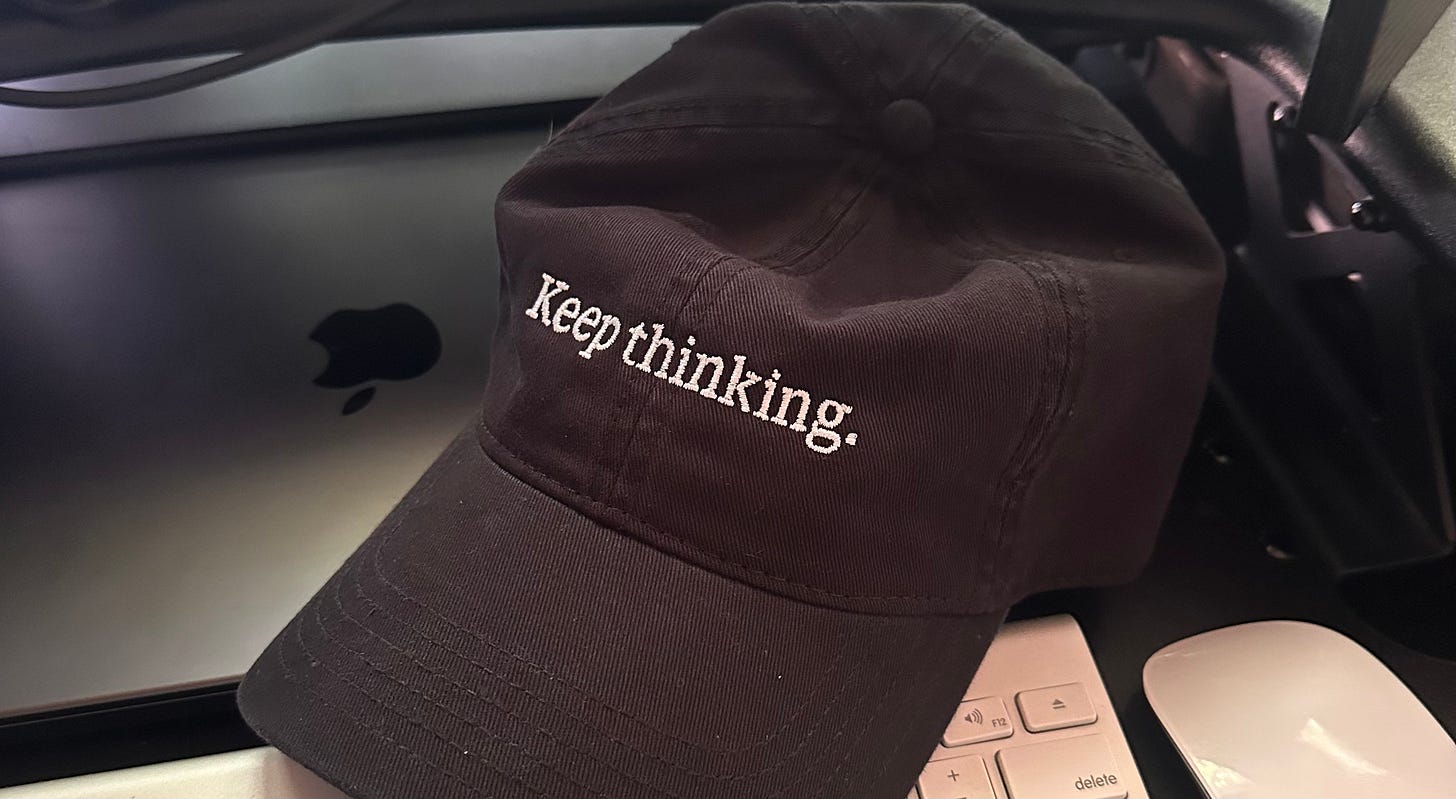
A PITCH: FAMILY-CENTERED AI MENTORSHIP
August 13, 2026The following pitch was drafted hours before a pitch competition hosted by Anthropic. However, the ideas have been incubating for months, and a love for the medium — in person, educational, mentorship — has existed for as long as I can remember. Here’s the 60 second pitch as I delivered it last night, followed by some ideas on what’s next.
Aristotle said the unexamined life is not worth living.
I would argue that the unexamined product is not worth building.
Further, the unexamined chat with Claude, not worth having.My name is Graham and I am building toward problem #1 — critical thinking — with a mentorship program for kids and parents.
Critical thinking is an extension of the type of person that thinks critically. Institutions like the academy, the church, and the family are failing to form these “types of people” in light of the breakneck speed of AI innovation. They are failing because:
- They don’t want to engage,
- They don’t have capacity to engage,
- They don’t know how to engage.
And people are getting formed by chats with Claude instead.
My solution seeks to empower the institution of the family with a philosophical foundation, and to equip them with basic technical skills so that they don’t just know how to scope and build a solution, but why they are build and at what they are trading off.
I am seeking educators, philosophers, guest speakers, mentors, students, hardware, a venue, and anyone that is willing to fill in the gaps.
Last I checked, “Connectedness” is my top strength according to Gallup Strengths-Finder. I find this manifesting in my pursuit of a cohesive worldview, but also in seeking the connective tissue in day-to-day experiences like ideas and opportunities and experiences. Instinctively, for better or worse, I’m usually trying to find a way to make all the puzzle pieces fit on the board. However, I am equally rational and logical, which means I interrogate the life out of magical coincidences. Perhaps the gods would say I’m hard to please.
Throat-clearing behind us, let’s talk magic.
“Means & Meaning” began as an provocative idea: “With rapidly increasing technological means, what does it mean to live a meaningful life?” A response to that question began by writing on Substack. Through publishing imperfect work, I discovered the art of writing-as-thinking, but personal philosophizing fell short of what I felt this question deserved.
My research over several months uncovered individuals and organizations that were working toward an answer in their own way. Praxis (faith-based start-up incubator) empowers redemptive entrepreneurship. L.M. Sacasas (scholar of technology and culture) waxes eloquent on technology and philosophy. But the organization that came closest to addressing the heart of the “Means & Meaning” question was the Cosmos Institute. Cosmos is a nonprofit seeking to promote a free society through human autonomy, reason, and decentralization. They have a strong body of written and visual content, and they also provide grants and fellowships to those they call “philosopher-builders.”
Twenty-something I am, without a masters degree much less a PhD, lacking experience in research, lacking experience traditional development, lacking experience founding, funding, or exiting companies left me asking, “How do I join this conversation I care about in a meaningful way?”
It has been a network of people that have led me, and are leading me, to an answer.
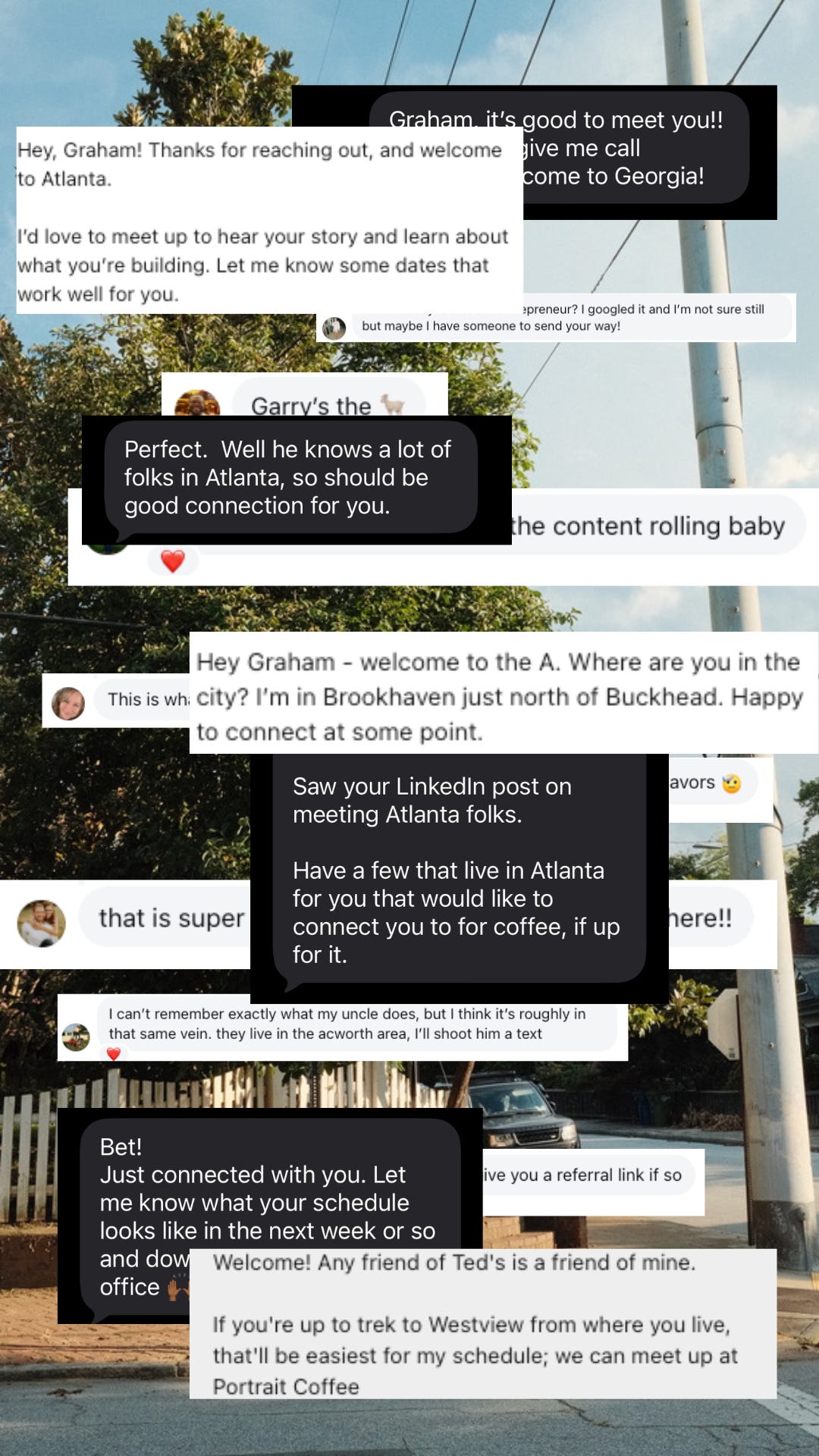
I launched a networking campaign at the beginning of this week. In keeping with the practice of “shipping imperfect work,” it all felt raw and unfinished — pieced together on a Sunday evening and shipped at 10:00 PM — but it was time.
Four days later, I have 15 meetings booked, purely based on the goodwill of people and openness to a thoughtful conversation.
“Crowd sourcing” is the word that comes to mind. Usually, it’s not a word that engenders an emotional response, but now it kind of does. It’s also empowering insofar as it represents a bottom-up approach to creativity, to development, and to meaning.
Now, if I hit my goal of meeting 50 people in 2 months, and 50% them agree to be on a “Means & Meaning” podcast to talk about themselves, technology, their business, and the impact on the community, that will be 25 quality conversations and I would be proud of that. In fact, I would love to have interesting conversations with people for a living. But the pitch competition helped me ask, to what end? Best case scenario — subscribers accumulate over time and they are encouraged, inspired, and informed of the redemptive use of means to further the common good. Ideally, I’d love for some practical insights to come from these conversations to educate and empower people too. (Are these people everyday citizens, knowledge workers, founders, leaders? I don’t know — the market will dictate this.)
Even still, the impact of thoughtful podcast conversations is limited to those who choose to invest time listening or reading the conversation, to the degree that it resonates with them uniquely. This is not to be dismissed. There is power in our words. There are countless times I’ve been encouraged, or provoked, or relieved by the words of someone on a podcast. Long-form conversations and writing have power, but in the attention economy, content’s “staying power” has a shelf life.
People are formed by their repeated actions, and Formed (capital-F) by institutions that offer a system of belief, behavior, and reward. The institutions that most effectively “Form” individuals into a definitive type of person are 1) religious institutions (e.g., churches, synagogues, monasteries), 2) academic institutions (e.g., schools, universities, seminaries), 3) mastery institutions (e.g., sports teams, bands, the military), 4) familial institutions (e.g., households, marriages, chosen family). Without these, formation is delegated to a form a society inevitably influenced by governmental policy, and increasingly in the 20th century, media. Now that most of our media is driven by algorithms, these three entities (big government, big tech, and media) form an unholy trinity worthy of the word, “de-formation.” Perhaps in years to come, “assimilation.” But this is what I’m solving for.
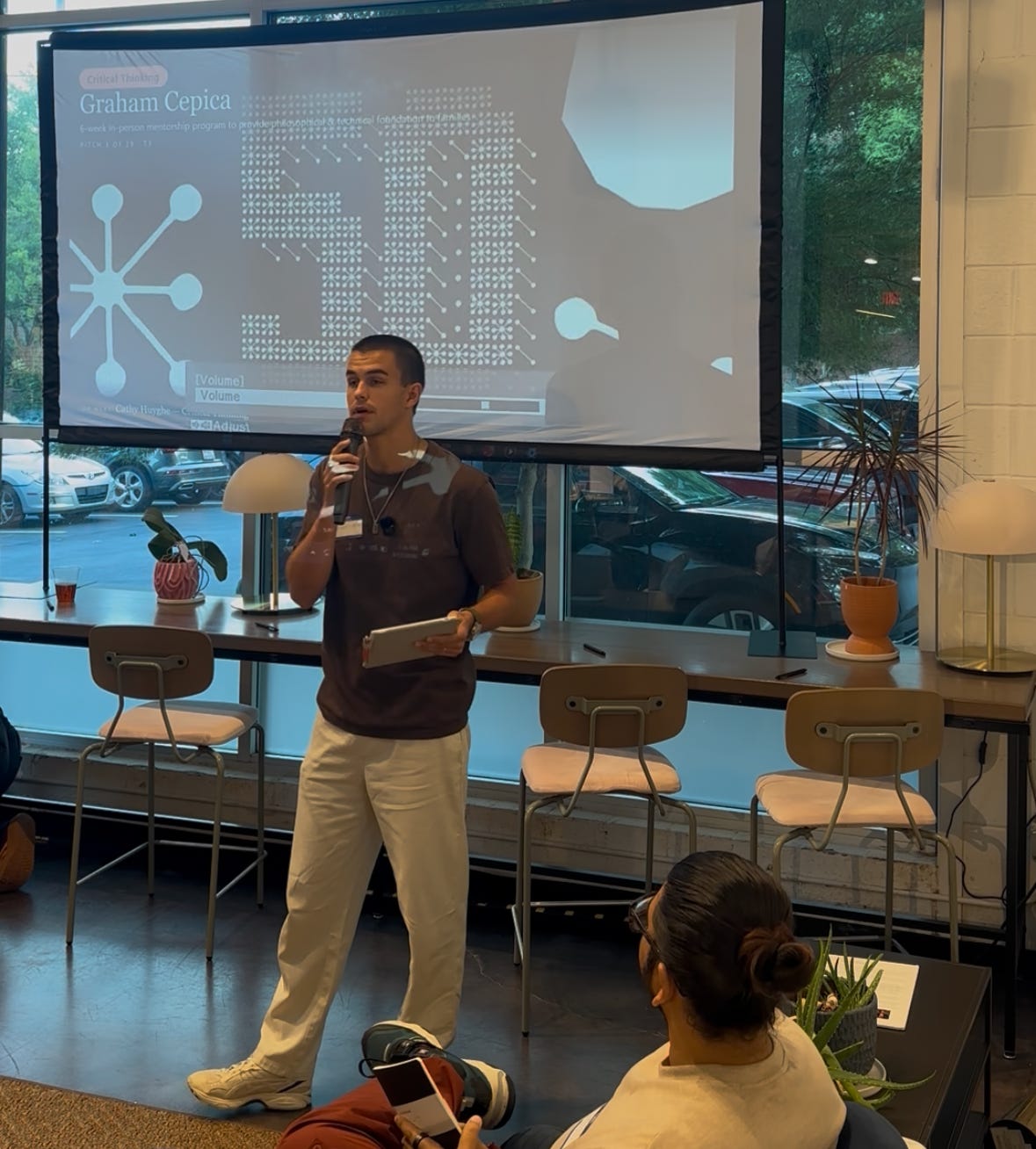
Part of the magic of this story is that I launched my networking campaign right before Atlanta Tech Week, which means the techie hive-mind energy is at an all-time-high. Anthropic has been leveraging this energy by hosting local events as part of their “Keep Thinking” campaign — one of which was a market research event that uncovered three key problems the community was facing in light of Artificial Intelligence, and another event where builders pitch against 1 of the 3 problems they uncovered.
- Critical Thinking
- Guardrails
- Access
Originally, I signed up for the waiting list for this ambiguous event, which had none of the information I just shared in the description. A couple days before the event, my registration was accepted. One day later, I got an email from the organizer about the pitch competition. Several hours before, I started to prepare the pitch.
With a year of personal philosophizing at my hip, the only problem I felt equipped to pitch against was problem #1, critical thinking. A session of verbal-processing with Aubrey led me to three defining attributes of my solution:
- In-person experiences
- The family
- Student-mentor relationships
We proceeded to watch Cosmos Institute YouTube videos (link 1, link 2), and I escaped to my office to write with one hour before it was time to leave.
People don’t do things for one of three reasons: They don’t want to, they don’t have capacity, or they don’t know how. I think the same is true for religious, academic, and familial institutions and their lack of engagement with technology. As an example, some churches/schools/families write off technology as secular, destructive, divisive, or downright evil, and respond with disassociation. Some churches/schools/families want to engage, but don’t have capacity because their primary mission is to preach the gospel on a Sunday morning, teach the assigned curriculum for the semester, or work to pay bills and get food on the table.
Instead of reforming or critiquing these institutions, my solution seeks to empower them from the bottom up. Namely, through the most intimate and powerful institution of all — the family. From one’s family flows the most acute environment for the formation of kids and adults for, on average, 18 years. Insofar as nurture triumphs over nature, the family forms the “type of person” that chooses to be part of a church or not, chooses to pursue higher education or a trade school, chooses to enlist in the military or become a pianist or join the NBA.
I am seeking to provide a philosophical and technical foundation for families so that when, not if, kids and parents are tempted to outsource their thinking and decision-making, they are able to think critically about technology in light of their full humanity — as heart, soul, mind, strength beings. This is accomplished through a 6-week, in-person mentorship program.
My solution is based on the assumption that we as humans have a heart, mind, soul, and strength, and therefore exist in our fullest form when all of these things are addressed — not just the intellect. That’s why in-person experiences are at the foundation.
For students that want to learn but don’t have a parent willing to attend, a mentor may be assigned to them. For mentors that have something to give but nobody to give to, a student may be assigned to them. The same logic applies to parents, principals, or pastors that want their people to learn but don’t have capacity (or desire) to participate themselves — the program makes sure nobody that wants to learn is left alone.
In contrast to partnership and community, consumer technology is increasingly becoming a “single player game.” What began with mass customization through predictive social media algorithms has become a personal chat bot that knows you, in a way, better than you know yourself. This solution seeks to insert a human in the loop — a student that learns from a mentor and a mentor that learns from a student, working through a curriculum designed to foster critical thinking skills, using technology like Artificial Intelligence as an illustration and instrument.
This program assumes a desire to learn and be formed into the type of person that thinks critically through a commitment to a small community for a pre-determined amount of time.
Practically speaking, there are several loose ends.
- Where will this take place in Atlanta — a library, a school, a co-working space?
- Will computers be provided? If so, by whom, and how?
- Who with the right credentials will help design the curriculum?
- How will we measure success of critical thinking?
- What will participants build/how will we incorporate AI?
- How will we acquire mentors, students, and get in touch with families — through churches, schools, civic organizations?
The feedback has been positive. I am thankful to Anthropic for hosting the event as part of their Keep Thinking campaign; I am thankful to the prior session that uncovered the hopes and fears of the community and arrived at the three problems; I am thankful for the people that have introduced me to their network and to those that have agreed to meet for coffee; perhaps most of all, I am thankful to the people that have encouraged me to keep writing-as-thinking over the past year or so.
Keep thinking.