50 conversations
August 9, 2026I’ve wanted to start a podcast for over 6 months now, but I didn’t know how to start until I left my job and moved across the country.
The quest began with a great idea, an idea perfect for an unaddressed, high-demand niche. I even convinced a couple people to have recorded conversations with me (thanks Riley Simpson and Scott Frazier). Those conversations never saw the light of day. Mostly because the idea was never truly mine, no matter how compelling of a narrative that I told myself. An idea is only as powerful as the conviction of its host, and my conviction was misplaced.
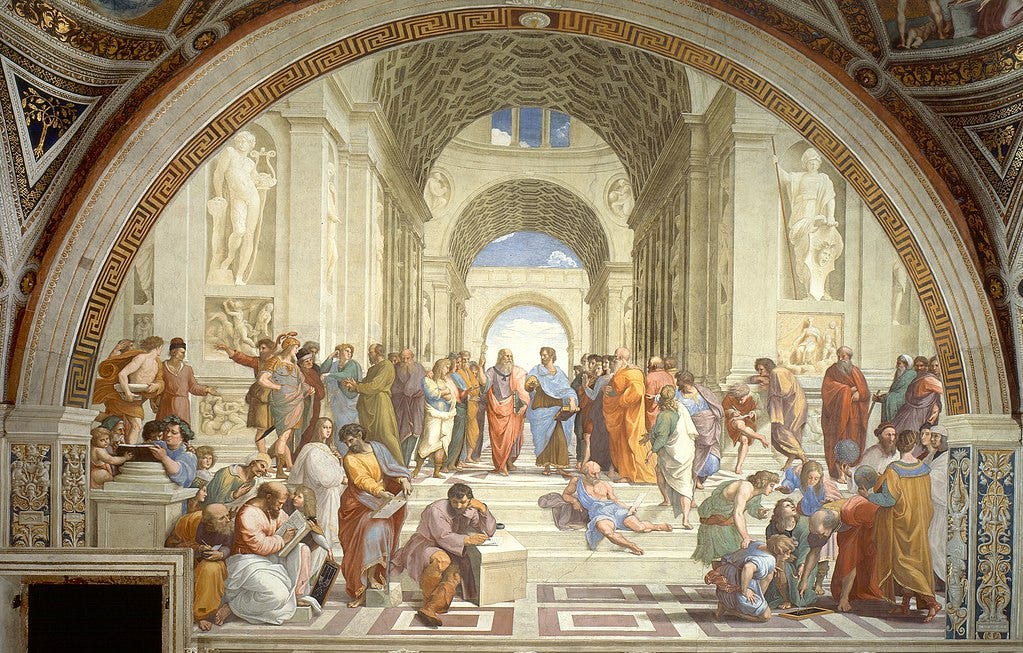
The School of Athens - Raphael (1509–1511)
Ancient Greeks had two ways they thought about time: Kronos time and Kairos time. Kronos time is that of clocks and calendars, hours and days — it’s inherently quantitative and especially useful for managing and planning. Kairos time, on the other hand, is less quantitative and more qualitative. It’s defined by an inciting event, an in-breaking. When a Kairos-moment happens, nothing will ever be the same afterward. People distinguish time before the Kairos-event from time after the Kairos-event. In all of our longings and reflections, we are thinking in either terms of Kronos time or Kairos time, and as thought about my podcast, I was secretly hoping for a Kairos moment. Now that time has come, and I’m missing an essential ingredient.
Scholar John Paul Lederach studies Kairos moments for a living. The Civil Rights movement, the Reformation, spiritual revivals and protests on the street — Ledarch says that what we see as “critical mass” is often preceded by years, decades, sometimes generations of critical yeast — “small groups of people in unlikely combinations, in a new quality of relationship.” And it’s these yeasty individuals that stick around after the upheaval, helping turn a critical moment into long-term transformation.
Kairos moments happen because of Kronos diligence. Kronos attentiveness. Kronos joy. Said another way: The kingdom of heaven is like a mustard seed, the smallest of seeds, but when it grows, it becomes the tallest plant in the garden… the kingdom of heaven is like yeast that a woman hides in dough until the whole batch is leavened (Matt. 13:31–33). This seemingly insignificant, unexpected, but powerful dynamic is one of my strongest convictions, and I believe that it occurs amongst people and even applies to this podcast project.
With that, my convictions have shifted from Kairos to Kronos, from “Podcast” to genuine conversations. For those still interested, there is some housekeeping in order. In attempt to answer these three questions, I created a mental model for the both of us.
- What is this, actually?
- How will it happen?
- Who is it for?
What is this?
An evergreen library of conversations with social entrepreneurs in the Atlanta metro area.
Reggie James said it best: Podcasts can either be based current events (time-bound) or evergreen, information-dense or they can be character-dense.
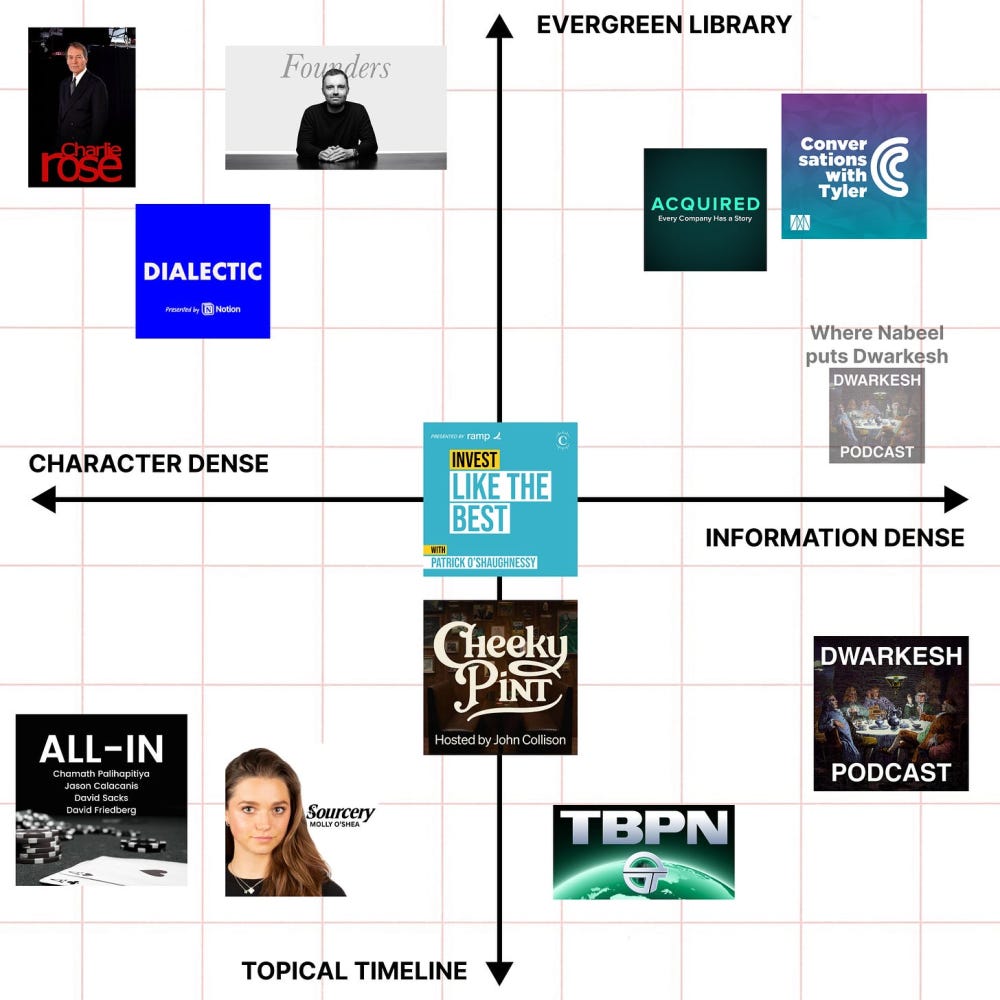
My working approach is to be up and to the left — social entrepreneurs (their story, their business model, their mission) and thus evergreen. Further still, I am limiting my geographic area to the Atlanta metro. Perhaps a different metro area can be featured another time, but my conviction centers around people and relationships which are:
- Inherently limited in scope.
- Most effective in a local context.
- Synergistic in their unique pursuit of the common good. (This dynamic is begging to be explored.)
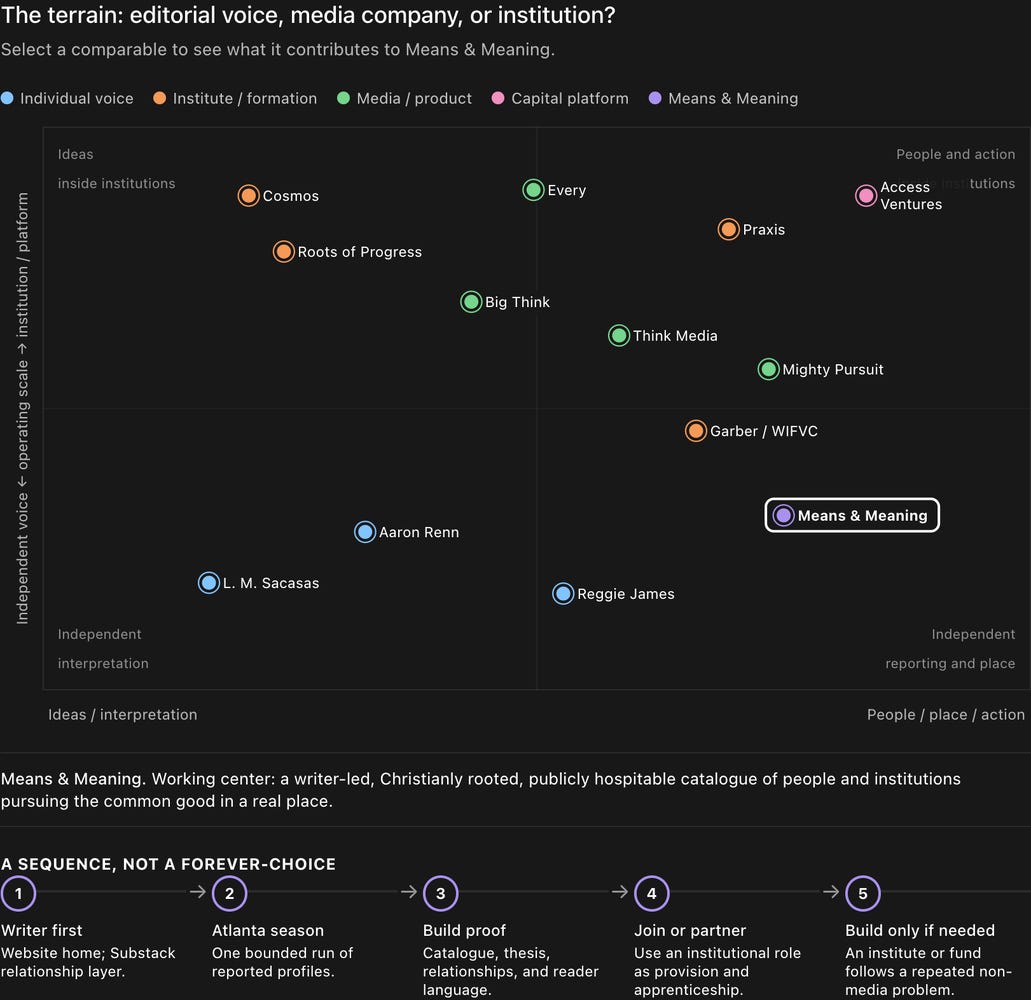
I didn’t arrive at this idea on my own. In fact, comparable platforms and individuals have been the single most helpful tool in helping me define what my vision is and what it’s not. Here are some examples:
I even created a comparison database you can review here, and a matrix here:
I’ll document the journey in real-time and the conversations retroactively.
I’m viewing this as a fixed project — 50 social entrepreneurs in about 2 months. I’ll profile each conversation and publish artifacts on social platforms. I don’t intend for any initial conversations to be recorded, this is pure discovery and connection, so they will likely be written.
Recorded conversations, should this prove fruitful, will come after the disovery project is over.
How will it happen?
Through people I know, like yourself, and through people I don’t know yet, who I look forward to meeting.
Who is it for?
- Anyone interested in the how people are pursuing the common good in the city of Atlanta.
- People who want to understand what meaningful building looks like in a real place.
- People interested in the ballistic pursuit of genuine conversations between strangers.
- Social entrepreneurs seeking a conversation with a curious, well-prepared writer.
Final thoughts
- This is all unfolding in real time.
- I believe this is an inflection point.
- I am relying wholly on the goodwill of other people.
- I am committing to document the project accurately and honestly.
Thanks for making it this far. If you want to support, here some ways:
- Introduce me to someone you know in Atlanta → gcepica@gmail.com
- Follow and engage with the content in real time (seriously, it helps) → LinkedIn, Substack, Instagram, YouTube
- Sponsor a coffee meeting → @ graham-cepica on Venmo or message me “coffee” on LinkedIn ❤️